
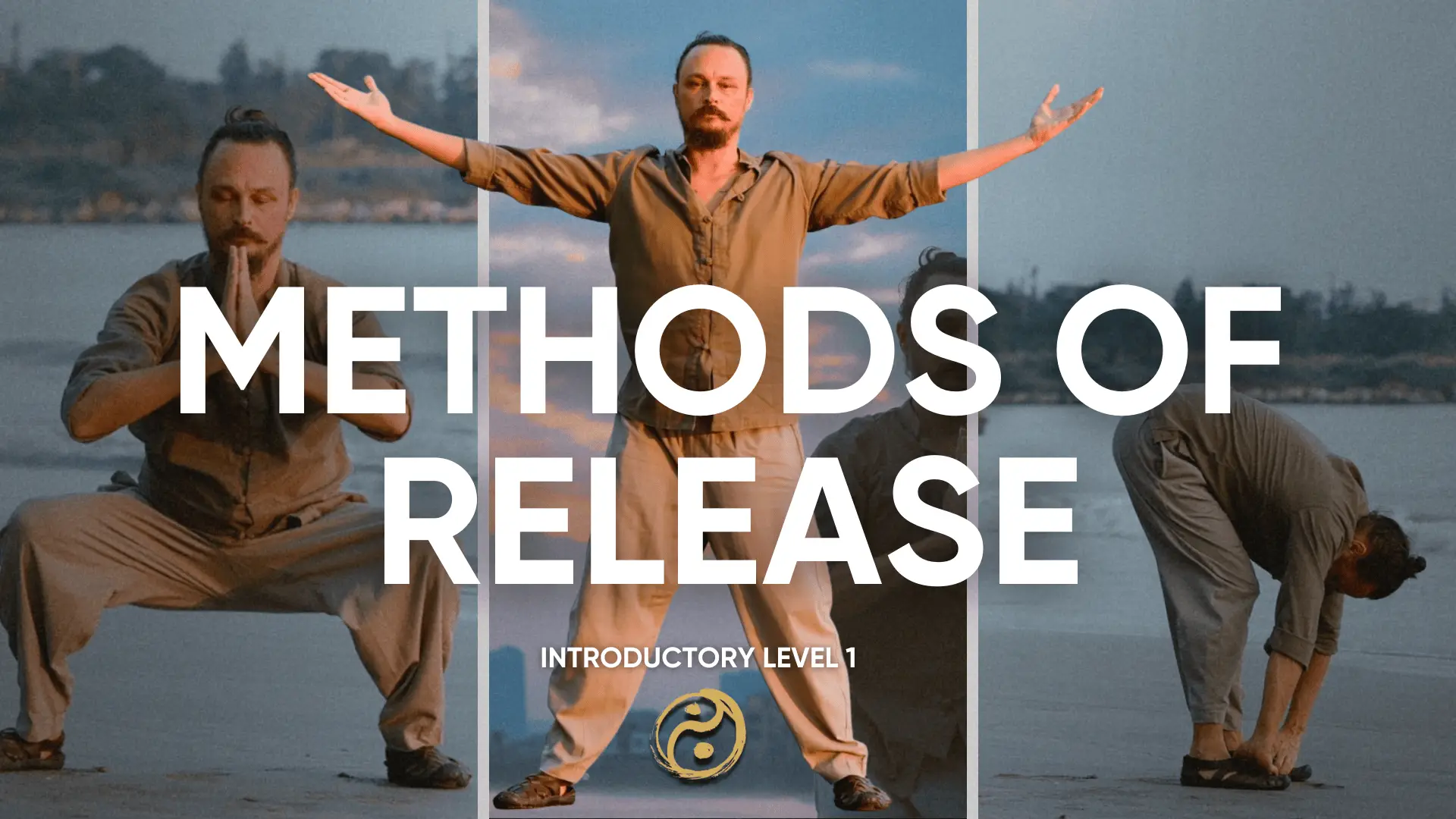
This class teaches five precise release methods drawn from Traditional Tai Chi training. Each method works through rotational momentum, compression and rebound, spinal articulation, and breath-coordinated movement to dissolve accumulated tension without force.
Practitioners seeking deeper body release beyond surface stretching
Those experiencing stiffness in hips, shoulders, spine, or ankles
Students preparing for formal Tai Chi training
Professionals needing a structured tension reset
Clear mechanical instruction
Alignment-focused training
No aggressive stretching
Built from lineage-based internal training principles
These methods retrain how your body releases tension — rather than forcing flexibility.
This is not stretching in the conventional sense. You are not pulling muscles to increase passive range.
Instead, the work relies on:
rotational momentum
compression and rebound
sequential spinal movement
breath-led weight transfer
Greater range of motion emerges as a result of improved mechanics — not added effort.
This is not performance or choreography. The shape of the body is guided by internal feeling and structural accuracy, not external appearance.
The aim is mechanical reorganization through correct alignment, timing, and release.

The Methods of Release are foundational auxiliary exercises used in traditional Tai Chi training to prepare the body for deeper internal practice.
This program introduces five structured methods that systematically develop:
Rotational mobility of the torso and shoulders
Ankle compression and elastic rebound
Sequential spinal articulation and upright alignment
Hip and knee integrity through controlled squat mechanics
Breath-coordinated forward folding and integrated weight transfer
Each method builds progressively from simple weight shifting to more integrated full-body coordination. Clear alignment instruction ensures the work remains safe, controlled, and repeatable.
The training is deliberate rather than strenuous, making it suitable for consistent practice while steadily improving mobility, posture, and structural efficiency.
The Methods of Release are foundational auxiliary exercises used in traditional Tai Chi training to prepare the body for deeper internal practice.
This program introduces five structured methods that systematically develop:
Rotational mobility of the torso and shoulders
Ankle compression and elastic rebound
Sequential spinal articulation and upright alignment
Hip and knee integrity through controlled squat mechanics
Breath-coordinated forward folding and integrated weight transfer
Each method builds progressively from simple weight shifting to more integrated full-body coordination. Clear alignment instruction ensures the work remains safe, controlled, and repeatable.
The training is deliberate rather than strenuous, making it suitable for consistent practice while steadily improving mobility, posture, and structural efficiency.

Level:
Beginner to Intermediate
Duration:
Approx. 15 minutes
Format:
Guided instruction
Focus Areas:
Compression & rebound
Spinal articulation
Breath coordination
Structural alignment
Practice Frequency:
2–4 times per week recommended
No acute knee, ankle, or spinal injury
Basic balance and coordination
Comfortable clothing allowing full range of motion
Flat, stable practice surface
Approximately 2–3 square meters of clear space

 Google